Places to visit in Vietnam
Planning a trip to Vietnam? Here is a complete guide to the best places to visit—from popular tourist attractions to offbeat spots you would not find in every guidebook. Get ready to explore, experience, and fall in love with Vietnam!
Top 152 curated places to visit in Vietnam
Fairy Stream (Suoi Tien)
Fairy Stream (Suối Tiên) is a small, shallow stream near Mui Ne/Phan Thiet notable for its striking geological formations: layered red sand, white clay and eroded miniature canyons. It is valued more for its unique natural and scenic qualities than for formal historical monuments. The site provides insight into coastal erosion processes and local coastal landscapes and has become an important, low-impact nature tourism attraction in the region.
Po Sah Inu Cham Towers
Po Sah Inu Cham Towers is a small Cham temple complex near Phan Rang–Tháp Chàm in Ninh Thuận Province, central Vietnam. Constructed by the Cham people, the complex is an important example of Cham religious architecture and craftsmanship and helps tell the story of the Cham civilization that flourished along Vietnam’s central coast. The site is valued for its red-brick construction, sandstone carvings and its role in preserving Cham cultural and religious traditions.
Xuan Huong Lake
Xuan Huong Lake (Hồ Xuân Hương) is the central artificial lake and a defining landmark of Đà Lạt, Lâm Đồng Province. Created during the French colonial period as part of the city's planning, the lake and its surrounding pine-lined promenades have become the social and cultural heart of Đà Lạt. It is valued for its scenic beauty, temperate climate, and role as a gathering place for locals and visitors, symbolizing the city’s romantic, garden-like character.
Tuyen Lam Lake
Tuyen Lam Lake is a large freshwater reservoir and one of the most scenic natural attractions around Đà Lạt (Lâm Đồng province). Surrounded by pine forests, rolling hills and tea plantations, the lake contributes to Đà Lạt's reputation as a cool, peaceful mountain retreat. It supports local biodiversity, leisure tourism and small-scale aquaculture and helps regulate local water resources.
Datanla Waterfall
Datanla Waterfall is a notable natural attraction near Đà Lạt, set within the region's characteristic pine-forested highlands. It showcases cascading falls, clear plunge pools, and karst-influenced rock formations typical of the Central Highlands. The site contributes to Đà Lạt's reputation as a cool-climate retreat and is a popular example of Vietnam's accessible mountain-waterfall scenery used for both relaxation and adventure tourism.
Pongour Waterfall
Pongour Waterfall (Thác Pongour) is one of Vietnam's most impressive highland waterfalls and a prominent natural landmark in Lâm Đồng Province. It sits within the Central Highlands' montane landscape and is valued for its dramatic multi-tiered cascade and basalt rock formations. The site is also part of the cultural landscape of the local K'Ho and other ethnic minority communities, contributing to regional identity and eco-tourism around Đà Lạt.
Elephant Falls (Lieng Rewoa)
Elephant Falls (Lieng Rewoa) is a well-known natural waterfall in Vietnam's Central Highlands, located near Đà Lạt in Lâm Đồng Province. The falls are valued for their scenic multi-tiered cascade, dramatic basalt and granite rock formations, and the surrounding montane forest typical of the region. The site is an important visitor attraction for those exploring Đà Lạt and the Central Highlands and also lies within the traditional lands of local ethnic groups (such as the Mạ and K'Ho), who have long associated the area with natural spirits and mountain-water life.
Langbiang Mountain
Langbiang Mountain (near Đà Lạt, Lâm Đồng province) is a prominent natural landmark of Vietnam's Central Highlands. It is valued for its scenic panoramic views over the Đà Lạt plateau, rich montane pine and cloud forests, and as a cultural heartland for local K'Ho (Koho) and other ethnic groups. The area is important for outdoor recreation, biodiversity conservation, and local cultural heritage.
Linh Phuoc Pagoda
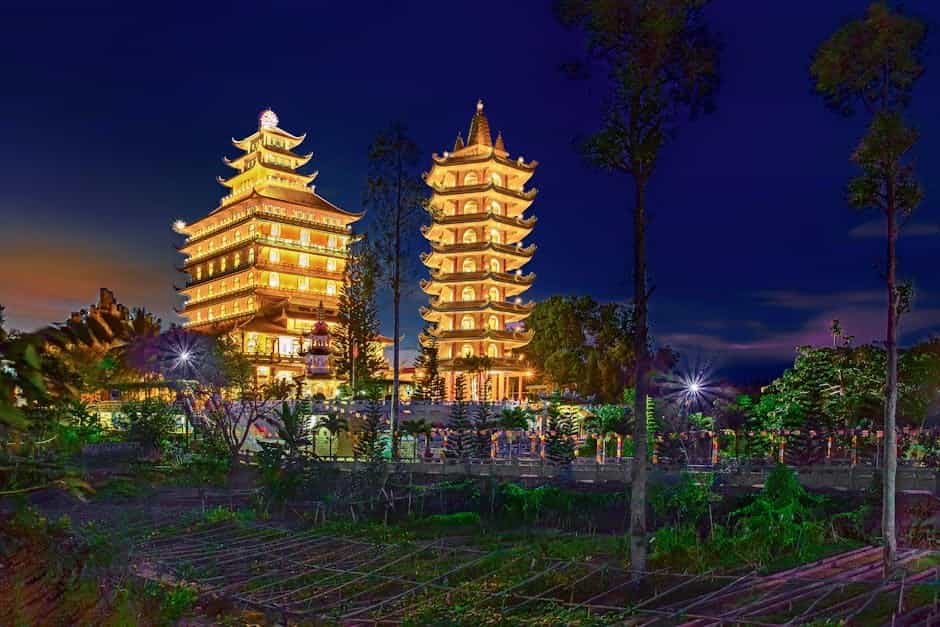
Linh Phuoc Pagoda (Chùa Linh Phước) is a prominent Buddhist temple near Đà Lạt, Lâm Đồng Province, Vietnam. Founded in the mid-20th century and expanded over subsequent decades, it is an important site for local religious practice, pilgrimage, and cultural tourism. The pagoda is particularly valued for its unique construction technique and strong representation of Vietnamese Buddhist art, drawing both worshippers and visitors interested in architecture and craft.
Crazy House (Hang Nga Guesthouse)
Architectural icon of Đà Lạt — Hang Nga Guesthouse (commonly called “Crazy House”) is a landmark of contemporary Vietnamese architecture created by architect Dang Viet Nga from the early 1990s. Combining expressionist and organic forms, it functions as both an unconventional guesthouse and an immersive sculptural environment. The building is significant for its bold, nature-inspired design (tree‑like structures, cave‑like rooms, animal motifs) and for attracting global attention to Đà Lạt’s cultural tourism.
Bidoup Nui Ba National Park
Bidoup Nui Ba National Park (Lam Dong province, Central Highlands, Vietnam) is one of the country's most important highland protected areas — notable for its montane evergreen forests, high biodiversity and many endemic species. The park conserves critical watershed forests for the Lang Biang plateau and plays a key role in regional climate regulation and water supply. It is also culturally significant to local ethnic groups (including K'Ho communities) who maintain traditional ties to the landscape.
Buon Ma Thuot Coffee Museum
The Buon Ma Thuot Coffee Museum celebrates Buon Ma Thuot's role as Vietnam's coffee capital and tells the story of coffee cultivation, processing and trade in the Central Highlands. It covers the introduction of coffee by French colonialists, the development of large‑scale plantations, and the influence of local ethnic groups (such as the Êđê and M'Nông) on planting techniques and coffee culture. The museum provides context on how coffee shaped the region's economy and identity.
Yok Don National Park
Yok Don National Park is one of Vietnam's largest protected areas and the country's most significant reserve of dry deciduous dipterocarp forest. Located in the Central Highlands, it protects unique lowland forest and savanna mosaics that are rare in Southeast Asia and supports populations of large mammals (notably the Asian elephant, gaur and various deer), rich birdlife and diverse plant communities. The park is also important for the indigenous Ede and M'nong communities whose cultural traditions and livelihoods are tied to the forest landscape. Yok Don forms part of a cross-border ecological landscape with adjoining forests in Cambodia, making it important for regional wildlife corridors and conservation planning.
Lak Lake
Lak Lake (Hồ Lắk) is one of the largest natural freshwater lakes in Vietnam's Central Highlands (Đắk Lắk province). It is ecologically important as a wetland habitat supporting local fish and bird species and as part of a landscape of pine forests and karst hills. Culturally the lake is central to the life of local ethnic groups—particularly the M'nông and Ê Đê—who maintain traditional stilt houses, communal longhouses, and customs tied to fishing, rice cultivation and forest resources. The area is also a scenic focal point for tourism in the highlands, combining nature, indigenous culture and coffee-country landscapes.
Kon Tum Wooden Church
Kon Tum Wooden Church (Nhà thờ gỗ Kon Tum) is an iconic early-20th-century wooden cathedral in Kon Tum city, Central Highlands, Vietnam. It represents a unique fusion of French missionary church architecture and local Central Highlands craftsmanship, serving as both a religious center for local Catholics and a cultural landmark reflecting the interaction between European missionaries and indigenous Bahnar and Jarai communities.
Mang Den Ecotourism Area
Măng Đen Ecotourism Area, located on the Kon Plong Plateau in Kon Tum province (Central Highlands of Vietnam), is valued for its cool highland climate, extensive pine forests, wetlands, lakes and waterfalls. It acts as an important conservation area for montane flora and fauna, and preserves the traditional lifestyles and cultural identity of local ethnic groups, notably the Bahnar and Xơ Đăng (Sedang). The area's landscapes and biodiversity make it a growing destination for low-impact ecotourism and nature-based recreation.
Notre Dame Cathedral Basilica of Saigon
Built during the French colonial period, the Cathedral Basilica of Our Lady of The Immaculate Conception (commonly called Notre-Dame Cathedral Basilica of Saigon) is a major religious and architectural landmark in Ho Chi Minh City. It serves as the seat of the Roman Catholic Archdiocese of Ho Chi Minh City and is an outstanding example of 19th-century Neo-Romanesque design in Southeast Asia. The cathedral symbolizes the French colonial legacy in Vietnam and remains an active center of worship and community gatherings.
Saigon Central Post Office
Saigon Central Post Office (Bưu điện Trung tâm Sài Gòn) is a landmark of Ho Chi Minh City and an outstanding example of late 19th-century French colonial architecture in Vietnam. Built between 1886–1891 during French rule, the building has been a functioning post office and a visual symbol of Saigon’s colonial-era urban core, located beside Notre-Dame Cathedral Basilica of Saigon. It represents the city’s historical role as a regional administrative and communications hub and remains popular with both locals and visitors.
Ben Thanh Market
Ben Thanh Market (Chợ Bến Thành) is one of Ho Chi Minh City's most iconic landmarks and a living symbol of Saigon. Its origins trace to a riverside market serving the settlement long before French colonial times; the current market building dates to the early 20th century and reflects the city's commercial heart. It remains a major center for daily commerce, social interaction, and tourism—showcasing Vietnam’s culinary, textile and handicraft traditions in one place.
War Remnants Museum
The War Remnants Museum in Ho Chi Minh City (formerly Saigon) is one of Vietnam's most prominent museums documenting the impact and human costs of the Vietnam War (known in Vietnam as the American War) and earlier conflicts. Housed in a former U.S. Information Agency building, the museum presents photographic, documentary and material evidence of wartime suffering, civilian casualties, and the lasting environmental and health effects, such as those from Agent Orange. It serves both as a site of remembrance and as an educational institution for domestic and international visitors.