Places to visit in Rajasthan
Planning a trip to Rajasthan? Here is a complete guide to the best places to visit—from popular tourist attractions to offbeat spots you would not find in every guidebook. Get ready to explore, experience, and fall in love with Rajasthan!
Top 112 curated places to visit in Rajasthan
Kumbhalgarh Wildlife Sanctuary
Kumbhalgarh Wildlife Sanctuary sits on the Aravalli Range in Rajasthan and forms an important biodiversity and cultural landscape around the 15th-century Kumbhalgarh Fort. The sanctuary protects dry deciduous and scrub forest ecosystems that provide habitat for large mammals, herbivores and a variety of birds and reptiles. It also functions as an ecological corridor in the Aravalli hills and conserves watershed areas that sustain local communities.
Shree Eklingji Temple
Eklingji Temple is a major Hindu temple complex dedicated to Lord Shiva (Eklingji) located in Kailashpuri village near Udaipur, Rajasthan. The temple is the family deity (kuladevta) of the Mewar dynasty and has been associated with the rulers of Mewar for centuries; historically the Maharana of Mewar governed in the name of Eklingji. The temple's significance includes its religious importance as a Shaivite pilgrimage site, its continuous patronage by the Sisodia Rajputs, and its architectural significance showcasing medieval Rajput and later temple constructions.
Shrinathji Temple, Nathdwara
Shrinathji Temple at Nathdwara is one of the most important Vaishnavite pilgrimage sites in Rajasthan and a central shrine of the Pushtimarg (Vallabhacharya) tradition. The temple houses the black marble deity of Shrinathji — a form of Lord Krishna as a seven-year-old lifting Govardhan Hill — which was moved from Mathura in the 17th century to protect it from Mughal persecution. Nathdwara (literally "the gateway to the Lord") developed around the temple and remains a living center of devotional worship, traditional ritual seva, classical music and temple art forms such as Pichwai paintings and miniature painting schools.
Ranakpur Jain Temple
Ranakpur Jain Temple (15th century) is one of the most important and architecturally outstanding Jain temples in India. Dedicated to Tirthankara Adinatha (Rishabhanatha), it represents the apex of medieval Jain marble architecture in the Aravali foothills of Rajasthan. The complex is a major pilgrimage site for Digambara Jains and a key cultural monument showcasing Rajasthan's syncretic patronage — reportedly supported by the Rajput ruler Rana Kumbha and a wealthy Jain patron. The temple is noted for its devotional significance, artistry, and the way it integrates sacred geometry, proportion and delicate carving.
The location in a wooded valley adds natural serenity and a scenic backdrop that enhances spiritual atmosphere.
Jawai Leopard Reserve
Jawai Leopard Reserve (around Jawai Bandh, Pali district, Rajasthan) is a unique community-managed landscape notable for its high density of leopards living alongside human settlements. The area combines dramatic granite boulder-strewn terrain, the Jawai Dam and its seasonal lake, and dry scrub/grassland habitats — creating important habitat for large carnivores, resident and migratory waterbirds, and other wildlife. The reserve is an important example of human–wildlife coexistence driven by local communities and eco-tourism initiatives.
Nagaur Fort (Ahhichatragarh)
Nagaur Fort (Ahhichatragarh) is a historic hill fort in Nagaur, Rajasthan, that has served as a strategic stronghold and regional seat of power for centuries. Sitting on a trade route between northern and western India, the fort reflects a layered history of Rajput and Muslim rule, with architectural elements and decorative work showing both Hindu and Islamic influences. The fort complex includes palaces, courtyards, temples and mosques, and is valued today for its architectural conservation, frescoes and carved stone work.
Khimsar Dunes
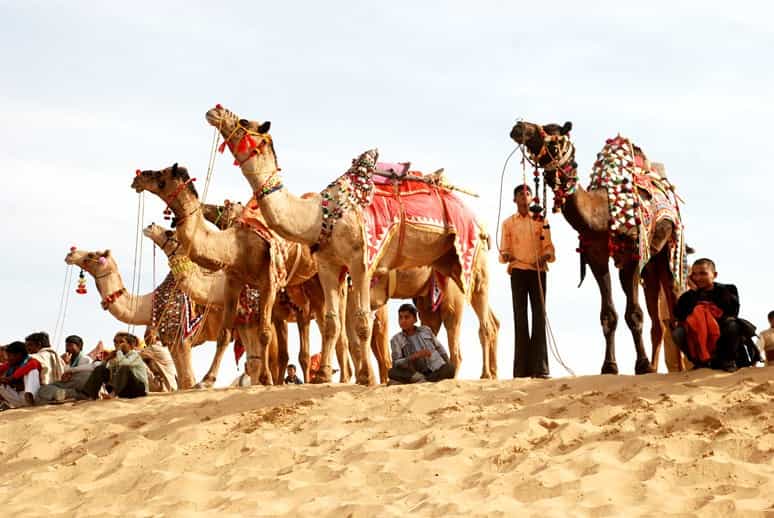
Khimsar sits at the edge of the Thar Desert in Rajasthan and is best known for the 17th‑century Khimsar Fort, a Rajput stronghold now operating as a heritage hotel. The location marks the meeting of desert ecology and agrarian village life — dunes, sparse shrubland, and date‑palm oases — and reflects Rajput architecture, desert adaptations, and traditional Rajasthani culture. Khimsar has historically been a stop on inland trade and caravan routes across the Thar.
Chand Baori, Abhaneri
Chand Baori is one of the oldest, deepest and most visually striking stepwells in India, built around the 8th–9th century (traditionally credited to King Chanda of the Nikumbha dynasty). It functioned as a community water-harvesting structure in arid Rajasthan and demonstrates sophisticated engineering and social planning for water conservation. The adjacent Harshat Mata Temple complex adds religious and cultural significance to the site.
Harshat Mata Temple
Harshat Mata Temple at Abhaneri (Rajasthan) is an early medieval Hindu temple dating from the Gurjara-Pratihara period (approx. 8th–10th century CE). It exemplifies northern Indian (Nagara) temple architecture and is significant for its fine stone carvings and sculptural detail. The temple complex, now largely in ruins, provides insight into the religious life and artistic traditions of early medieval Rajasthan. It stands close to the famous Chand Baori stepwell, forming part of an important archaeological and tourist ensemble.
Gagron Fort
Gagron Fort (Gagron) is a rare example of a hill-and-water fort in Rajasthan and was inscribed as part of the Hill Forts of Rajasthan (UNESCO World Heritage Site, 2013). The fort demonstrates medieval Rajput military architecture adapted to riverine and hilltop topography. Its stone ramparts, bastions and inner citadel reflect defensive design that used natural water barriers (rivers and a wide moat) together with fortifications to resist sieges. The site is culturally significant to local Rajput clans and the communities of Jhalawar district.
Taragarh Fort (Bundi)
Taragarh Fort (the 'Star Fort') is a 14th-century hill fort overlooking the historic town of Bundi in Rajasthan. It is an important example of Rajput military architecture with massive stone ramparts, strategic bastions and early examples of hilltop water-harvesting systems. The fort guarded Bundi for centuries and played a key role in the region's political and military history. Today it is prized for its panoramic views of Bundi, its ruins that reflect medieval construction techniques, and its contribution to the cultural landscape of Hadoti.
Raniji Ki Baori (Queen’s Stepwell)
Raniji Ki Baori (Queen’s Stepwell), Bundi is a late 17th-century stepwell built by Rani Nathavati in memory of her husband and for her son. It is an important example of Rajasthani stepwell architecture that combines utility with ornate aesthetics. The baori served as a water source, social gathering place and a cool retreat from the desert heat, reflecting local water-management practices and the socio-cultural role of stepwells in arid regions.
Sukh Mahal
Sukh Mahal is a small historic pleasure palace located on the banks of Gadsisar Lake in Jaisalmer, Rajasthan. It served as a retreat and leisure pavilion associated with the royal household and is part of the picturesque lakeside ensemble that supported the city’s water needs and social life. Architecturally, it reflects traditional Rajasthani sandstone construction with carved balconies (jharokhas), chhatris (domed pavilions) and ornamentation that mirror the region’s desert heritage.
Garadia Mahadev Temple & Canyon
Garadia Mahadev Temple is a small hilltop Shiva temple set in a dramatic natural canyon in the Aravalli/Marwar region of Rajasthan. It is primarily important as a place of local religious worship (dedicated to Lord Shiva) and as a scenic viewpoint offering panoramic views of the surrounding rocky landscape and river valley. The canyon and rock formations around the temple are geologically striking and popular with photographers and nature lovers.
Chambal River Safari
The Chambal River is one of northern India's cleanest rivers and an important conservation area that supports a unique ecosystem. The Chambal wildlife sanctuary and the National Chambal Sanctuary (spanning Rajasthan, Madhya Pradesh and Uttar Pradesh) protect endangered species such as the gharial (a fish-eating crocodile), the Ganges river dolphin, and the marsh crocodile. The river's deep ravines (locally called 'badlands') and relatively low human disturbance provide vital breeding and nesting habitats for many species and make it a key site for riverine conservation and eco-tourism.
Dilwara Temples
Dilwara Temples (near Mount Abu, Rajasthan) are a celebrated ensemble of Jain temples renowned for their exceptional marble craftsmanship and fine sculptural detail. Built between the 11th and 13th centuries and patronized by prominent Jain ministers (notably Vastupala and Tejapala), the complex is an important pilgrimage site for Svetambara Jains and a masterpiece of medieval Indian temple architecture. The temples sit amid the Aravalli hills, combining religious significance with scenic hill-station surroundings.
Nakki Lake
Nakki Lake, Mount Abu (Rajasthan) is the heart of Mount Abu — a sacred and scenic freshwater lake nestled in the Aravalli Range. It is an important cultural and natural landmark: used for local rituals, memorial ceremonies and as a focal point for tourism in the only hill station of Rajasthan. The lake's placid waters and surrounding granite hills create a unique microclimate and scenic setting that contrasts with Rajasthan's desert plains.
Guru Shikhar
Guru Shikhar is the highest peak of the Aravalli Range and the highest point in Rajasthan, standing at about 1,722 metres (5,650 ft). It is located in the Sirohi district near the hill-station of Mount Abu. The peak is important both naturally—as a vantage point offering panoramic views across the surrounding hills and plains—and culturally, because of the temple at its summit dedicated to the sage Dattatreya. Its status as Rajasthan's highest point makes it a notable landmark for geography and tourism in the state.
Kiradu Temples
Kiradu Temples are an important group of early medieval Hindu temple ruins in Rajasthan (Barmer district). The complex dates broadly to the 11th–13th centuries CE and showcases the Maru-Gurjara (Solanki) style of architecture, making it significant for the study of western Indian temple art, temple-building traditions, and medieval regional politics and society.
Shekhawati Havelis
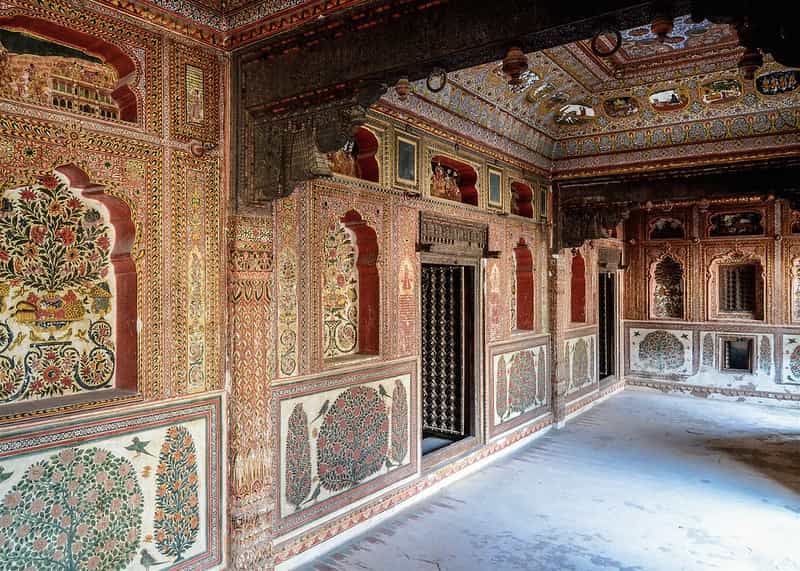
Shekhawati is an open‑air art gallery in the Shekhawati region of northeastern Rajasthan, famous for its richly painted havelis (merchant mansions) built mainly between the late 18th and early 20th centuries by prosperous Marwari trading families. The havelis display a unique fusion of Rajput, Mughal and European motifs and are a major example of vernacular architecture and fresco art in India. The region represents important social and economic history—showcasing the wealth of the Marwari diaspora, trade routes across northern India, and evolving tastes during the colonial period.